
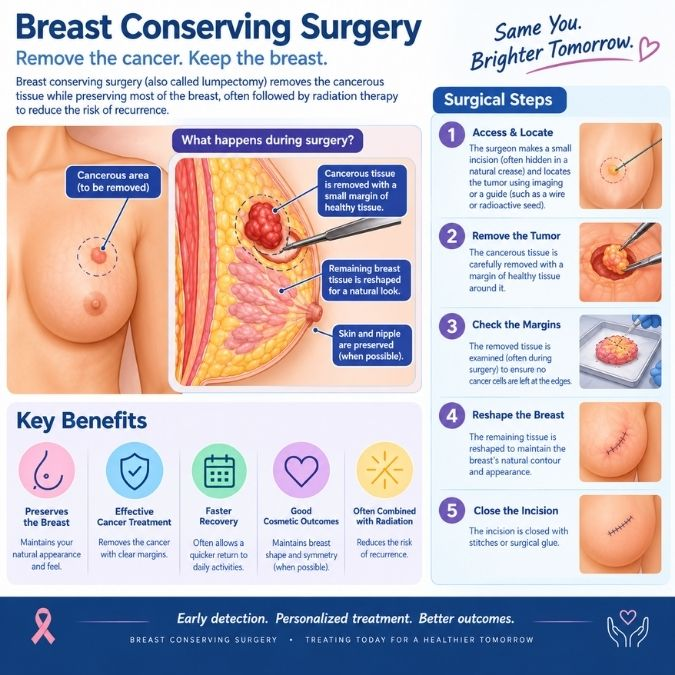
Breast conserving surgery is a specialized surgical procedure designed to remove cancer or abnormal tissue from the breast while leaving as much of the healthy breast intact as possible. This surgery is usually performed with precise, tissue-sparing techniques, and the common medical names for this procedure are “Lumpectomy” or “Partial Mastectomy.”
About the Breast
The breast is a specialized gland that rests over the pectoral muscles of the chest wall. It consists primarily of milk-producing glands (lobules), narrow tubular channels (ducts), and fatty or connective tissue. Its main biological purpose is to produce milk for lactation.
Unlike a full mastectomy, the selective removal of only a portion of the breast preserves the majority of the natural breast tissue and contour. Removal of a localized breast lump is not associated with the complete loss of normal breast function or physical mobility in most people.
What causes breast problems?
Breast problems that require conserving surgery are usually caused by the presence of early-stage breast cancer, precancerous cells like ductal carcinoma in situ (DCIS), or occasionally, growing benign lumps such as fibroadenomas.
It is uncertain exactly why some people form breast tumors, but risk factors include advancing age, being female, a family history of breast disease, and certain genetic factors. There is no known means to completely prevent breast cancer.
These abnormal cells or benign growths can multiply and form solid masses, resulting in palpable lumps, localized breast pain, skin changes, or noticeable abnormalities discovered during routine screenings.
How are these problems found and treated?
Mammograms and ultrasounds are most commonly used to find breast lumps and abnormal tissue. In a few more complex cases, other tests such as a Breast MRI or a targeted tissue biopsy may be used to definitively evaluate breast disease.
Breast cancer does not go away on its own. While some benign conditions can be temporarily managed by close observation, cancerous or highly suspicious tumors require physical extraction. Attempts to treat the disease without removing the primary tumor have a low success rate. Symptoms and disease progression will eventually continue unless the tumor is removed.
Surgical removal of the lump—very often paired with post-operative radiation therapy to ensure any remaining microscopic cancer cells are destroyed—is the time-honored and safest treatment for early-stage breast cancer that allows patients to safely preserve their breast.
©2026. Dr. Benito Tan Jr.. All Rights Reserved.